
Building the Hydrogen Workforce: Why Education, Safety, & Industry Collaboration Matter
An Interview with Dr. David Blekhman
The hydrogen economy is scaling, and with it comes a pressing need: skilled professionals who understand hydrogen systems, safety, and operations from the ground up. At AcuTech, we are consistently exploring and developing programs to support the safe generation, use, and transportation of hydrogen. Part of that effort is being aware of programs and activities already in place. In the spirt of awareness and amplification of effective programs, we asked Dr. David Blekham if he would be willing to discuss his work and we are grateful that he agreed.
Dr. Blekhman, Technical Director of the California State University, Los Angeles (Cal State LA) Hydrogen Research & Fueling Facility (HRFF), has been building that talent pipeline for nearly two decades. His work combines hands-on training, rigorous process safety education, and deep industry collaboration. This creates a model that produces hydrogen professionals ready for real-world deployment.
For National Hydrogen and Fuel Cell Day, we spoke with him about workforce development, the critical role of process safety training, and how industry and academia can work together to strengthen the hydrogen workforce pipeline.
Background & Career Focus
What is your background and what led you to focus on hydrogen workforce development?
I joined Cal State LA in 2007, when the university needed my expertise in hydrogen and fuel cells to lead the establishment of an on-campus hydrogen station-Cal State LA Hydrogen Research and Fueling Facility (HRFF). As the station matured, workforce development evolved naturally. Engineering students began serving as interns, often for a year or longer, gaining experience that helped them enter hydrogen-infrastructure careers.
Today, recent graduates entering the industry are trained by former Cal State LA students who preceded them. That continuity, together with our engagement of international graduate and postdoctoral researchers, led to our focus on building a sustainable hydrogen-workforce pipeline.
University Programs & Curriculum Development
How does your university program prepare the next generation of hydrogen experts? What skills should future engineers and safety professionals develop to work in the hydrogen sector?
Cal State LA prepares hydrogen professionals by layering specialized training onto conventional BS and MS degrees. Interns come from mechanical, electrical, civil, and technology engineering, as well as computer science, reflecting the interdisciplinary nature of hydrogen facilities. With California Energy Commission workforce funding, we were able to introduce a more formal two course training right at the station. Intern development follows a two-phase curriculum. Phase I covers onboarding, station layout, component functions, and foundational safety; Phase II advances to operations, maintenance, diagnostics, and equipment-specific knowledge. This training is reinforced through working at the station at the same time. Twenty-one interns over several years have helped refine the model, and more than half have moved into hydrogen employment.
Future engineers need depth in their primary major, but through the internship they acquire systems literacy: the ability to read P&IDs, understand how production, compression, storage, dispensing, instrumentation, and controls interact, and diagnose problems using operational data. Safety professionals also need enough technical knowledge to understand equipment behavior, human factors, and organizational risk—not only regulatory compliance. Formal safety training, including emergency-response and laboratory certification, reinforces that foundation.
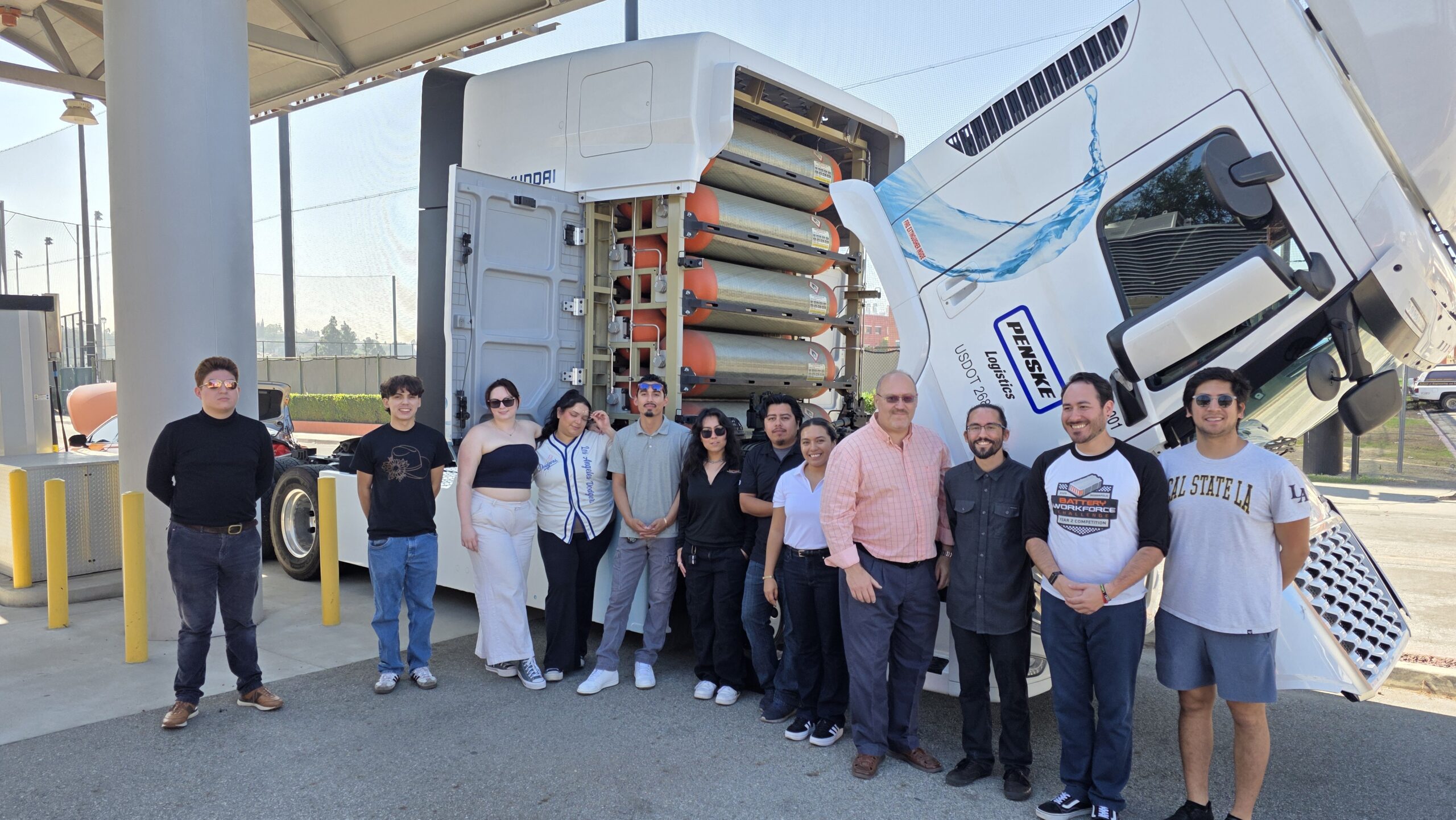
Dr. David Blekhman’s research group at Cal State LA with a hydrogen-powered Penske truck. Real equipment like this provides the foundation for students to develop systems literacy and practical hydrogen engineering skills. Image credit: Dr. David Blekhman, Cal State LA
Process Safety Training & Hazard Recognition
How do you train students to recognize and manage hazards that may be unique to hydrogen systems? Are aspects of process safety included in your curriculum or will these be included in the future?
In the training provided to our interns at the hydrogen station, students are learning the relations of hydrogen’s properties to hazards found in actual station equipment. Training addresses material safety, flammability and dispersion, high-pressure gas, leak and flame detection, ventilation, pressure relief, personal protective equipment, lockout-tagout, emergency response, and safe station tours. Students interpret facility layouts and P&IDs, examine fixed detectors and alarms, practice portable-sniffer walk-throughs, and study documented failures and near misses. Phase I also requires CHS First Responder, Spill Emergency Response Plan, and laboratory safety certifications. So, the theoretical material is connected instantly to what they are observing in the station operations.
Training Collaborations
For the past year, I have concentrated on developing a standalone applied hydrogen safety course through collaboration with the Center for Hydrogen Safety, AcuTech, Crystallogy Consulting, Dräger, Distran, and other industry experts and technical resources. Several students have also contributed through projects involving NFPA 2 and hydrogen safety equipment. The proposed course will progress from hydrogen properties, hazards, codes, and safety systems to case studies of increasing complexity. Students would begin with a safety plan and code review for a simple system, advance to an FMEA- or LOPA-based audit of detector coverage at the university station, and culminate in an integrated safety package for a fueling facility. This approach will move students from understanding prescriptive requirements toward exercising performance-based engineering judgment.
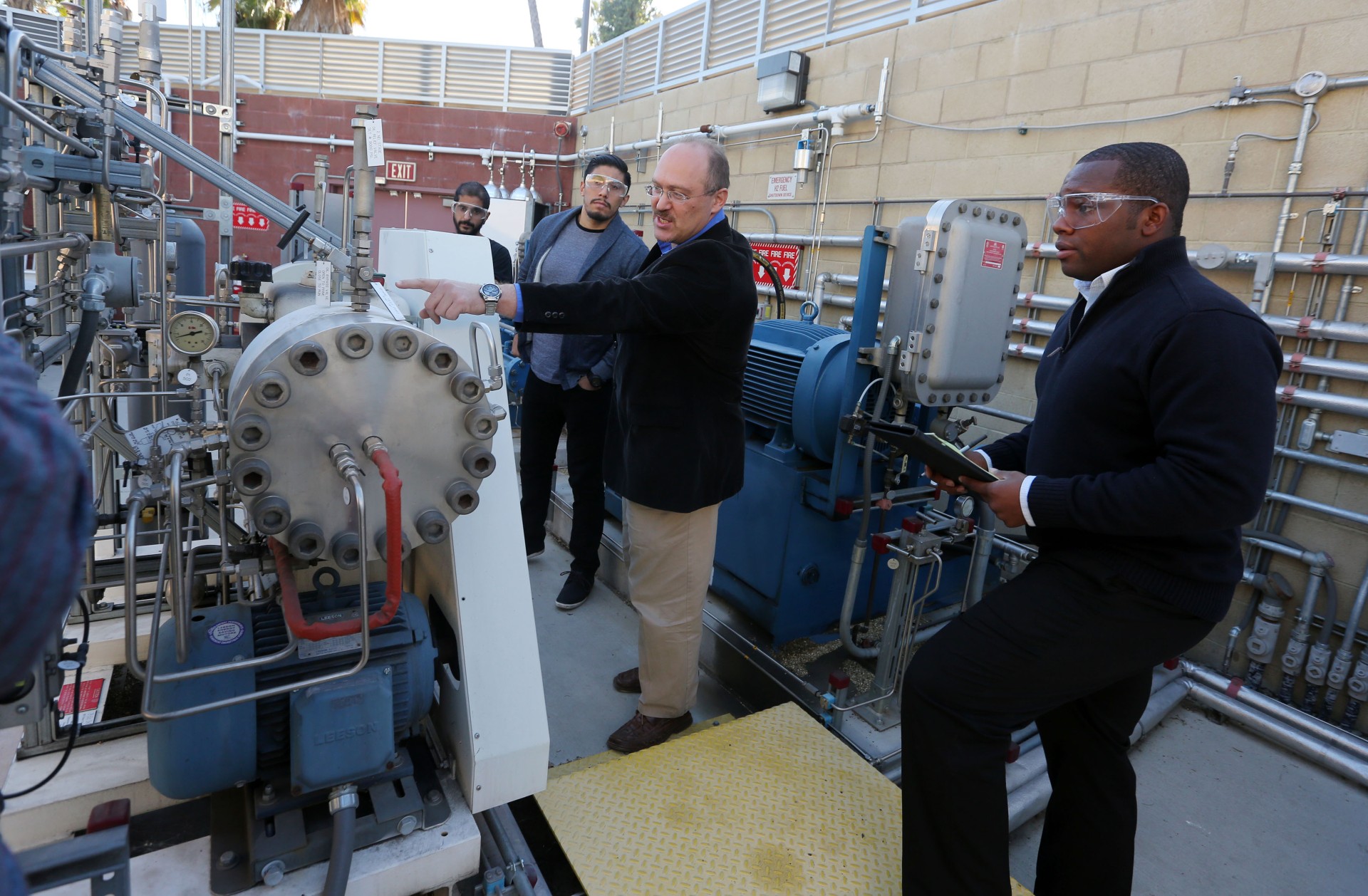
Dr. David Blekhman guides Cal State LA interns through hands-on hydrogen safety training at the Hydrogen Research and Fueling Facility (HRFF). Students learn to connect theoretical hydrogen properties directly to hazards found in operating equipment. Image credit: Dr. David Blekhman, Cal State LA
The Role of Hands-On Experience
What role does hands-on training during university years have in preparing the future hydrogen workforce?
Hands-on training is essential. Cal State LA provides a highly unusual opportunity: engineering students serve as interns at HRFF, an experience that may be unique worldwide. Students learn the station layout and equipment, assist with inspections, monitor control systems, maintain records, support fueling and tours, use portable sniffers to check for leaks, and study troubleshooting and preventive maintenance. Working with electrolyzers, compressors, storage, dispenser, sensors, and safety systems turn classroom principles into practical engineering experience. As a living laboratory, the HRFF is integrated into the Sustainable Energy and Transportation Engineering Technology curriculum—including Zero Emission Vehicle Technology, Data Acquisition and Control, and Fuel Cell Applications—to introduce students to hydrogen systems and subsystems through course-specific instruction on infrastructure and facility operations.
Having the opportunity to be in a lab like our hydrogen production facility, seeing the onsite equipment and gaining direct experience with detection and sensing technology helps build a sort of technical muscle memory. Because of that hands-on exposure, I’m able to identify core similarities and anticipate safety challenges when looking at other hydrogen applications across different fields.
– Nevin Velasquez, CalState LA Graduate Student
Process Safety as Foundation
Should new graduates be familiar with process safety, or should this remain a topic that engineers learn in the field as they advance in their careers?
Both are needed. Every hydrogen engineer should graduate with sufficient process-safety knowledge to understand hazards, interpret safety systems, and make sound decisions within an integrated hydrogen facility. This foundation is essential to becoming a well-rounded and proficient hydrogen engineer, regardless of specialization.
Engineers who enter safety-focused positions can then receive additional company- and site-specific training. Those seeking to become hydrogen-safety experts may continue through specialized academic and professional programs, such as those offered by Ulster University and the Center for Hydrogen Safety; gain applied experience with safety consulting firms such as AcuTech and others; and participate in codes and standards working groups. University education should establish the foundation, while industry, professional organizations, and specialized programs develop advanced expertise.
Working with hydrogen knowing its properties you cannot afford a ‘learn-as-you-go’ approach to safety. When new graduates enter the workforce already having a great understanding of process safety they don’t just adapt to the industry quicker they are able to help build a safer, more resilient environment from day one.
– Nevin Velasquez, CalState LA Graduate Student
Industry-Academia Collaboration Models
What are the most effective ways industry and academia can collaborate to develop the hydrogen workforce? What can employers do to better support student internships and research experiences?
The most effective collaboration occurs when industry moves beyond an advisory role and helps fund projects and mentoring at HRFF. We developed a six-month, industry-supported internship model that would allow an employer to support internships at HRFF while interns complete Phase I and II training with us and transitioning to the company afterwards. Because many hydrogen companies are still relatively small and prefer direct hiring, this internship model still could use other funding resources.
A second model links research students and curriculum directly to industry projects. Our collaboration with Rockettruck provided technical expertise grounded in mobile fuel‑cell generators, connecting student research with real equipment. Symbio partnered with us on curriculum for its Hydrogen Academy and opened its manufacturing facility for faculty visits.
A third model builds sustained workforce networks. Through the DOE‑funded H2EDGE initiative, Cal State LA and SoCalGas engaged in workshops, professional development, and networking. We have also collaborated with the Hydrogen and Fuel Cell Partnership for more than 15 years.
A fourth model is for government to fund academic Centers of Training Excellence at the BS and MS levels. These centers combine specialized curricula, laboratories, internships, applied research, faculty expertise, and industry guidance to create reliable regional talent pipelines. At present, however, funding for such efforts is inconsistent, making these programs difficult to sustain. Perhaps, industry could also promote establishing such centers to corresponding agencies.
Why This Matters to AcuTech
As Dr. Blekhman mentioned, industry experience and professional training are critical for early career engineers to gain expertise beyond that which universities can provide. For this reason, AcuTech offers advanced specialized training in process safety for hydrogen engineers, including:
- OSHA Process Safety Management (PSM) Overview
- EPA Risk Management Program (RMP) Overview
- Implementing California’s CalARP and CalOSHA PSM Program
- Best Practices in Process Safety and Risk Management
- Risk-Based Decision Making and Cost-Benefit Analysis
- Process Hazard Analysis (PHA) & Layer of Protection Analysis (LOPA) for Team Leaders/Members
- Human Factors and Procedure Analysis
- Incident Investigation & Root Cause Analysis
- Custom Hydrogen Safety Training
We partner with organizations, from small-scale hydrogen laboratories to bulk-scale chemical plants, to strengthen their workforce and equip them with knowledge and skills to become process safety leaders. Reach out to AcuTech for customized process safety training for your hydrogen project.